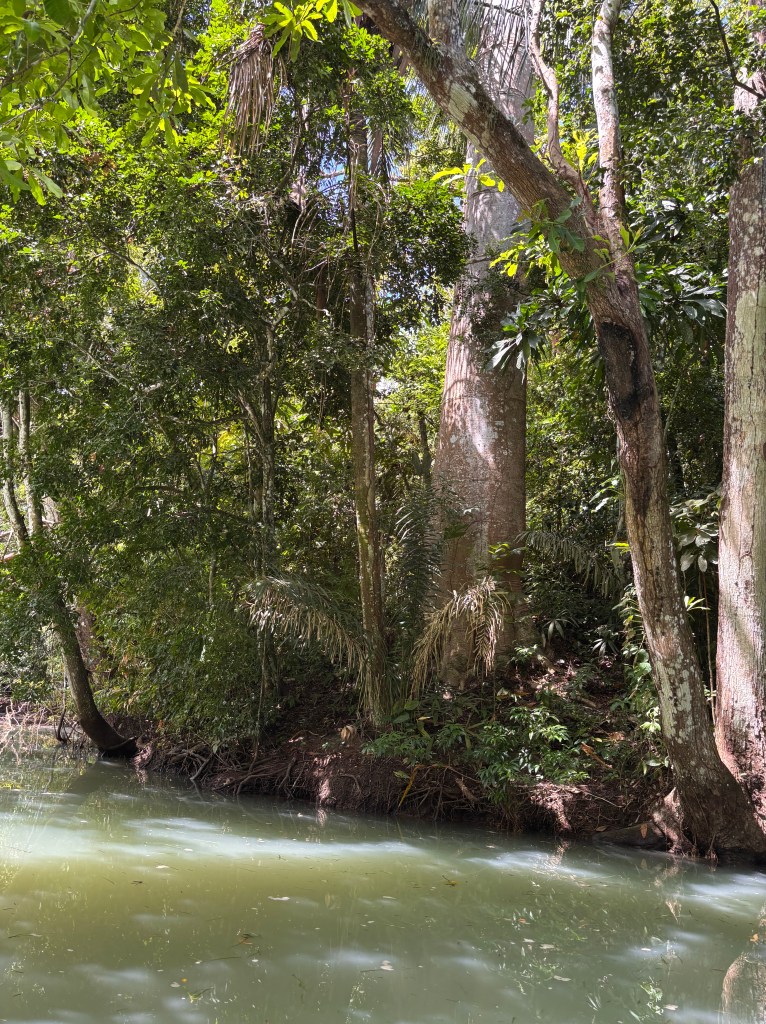
Two girls are in the rainforest in Panama, picking berries as dappled sunlight falls all around them. Laughing and giggling, they pick a few berries, taste a few, and put some in the basket. Their mouths are full of berry juice, and they wipe their hands on their pretty gingham dresses. Mina, 12, has dark, dense, curly brown hair and deep black eyes. She is skinny and lanky. Cheres is 4 years old, with short, silky hair, almond-caramel-brown eyes, and dimples. They are both barefoot and used to walking on the soft forest floor. The sounds of crickets and other chittering blend into the rainforest’s rich symphony. A long, loud whistle, a crack, and then a boom startle the girls. They drop the basket of berries and begin to run. Mina, with her long legs, pulls ahead of Cheres, soon losing sight of her younger sister. “Café!!” she calls out, desperate, looking around. Café is her little sister’s nickname. A short distance away, she can hear the villagers’ commotion, yelling and screaming. “Café!!!!!” she calls out again and again, tears of fright streaking her face. The booms continue, smoke billowing toward the village. The crackling of fire and more screams.
1968, Mina’s New York apartment in Washington Heights. Her apartment faces the building’s back alley and is smaller than the one across the hall, where her sisters-in-law, Julia and Maria, live. Her twelve-year-old niece, who also lives with Julia and Maria, has come to visit her great-aunt Mina. She arrives bouncing on her feet, bearing a freshly baked coffee cake sent by Maria. Elizabeth loves spending time with her very interesting and eccentric great-aunt Mina. There is so much to look at. Aunt Mina’s place is packed with exotic knick-knacks, colorful ceramic ashtrays, Spanish fans, dolls, and wooden artifacts. Silk flowers in vases, along with all kinds of plants that Aunt Maria doesn’t keep in her apartment. Intricately woven doilies cover the large, overstuffed, flowered furniture. The distinctive odor of roses, jasmine, and other Spanish flowers permeates the whole apartment. Aunt Mina, now in her 80s, is a serious, elegant lady who walks with a hand-carved wooden cane, her gray, curly hair packed under a hairnet, and always bears a smile for her niece, Elizabeth. She invites her to sit in the parlor, which makes Elizabeth feel like a grown-up on a proper visit. Elizabeth notices a lit, fragrant cigar on one of her aunt’s fancy ashtrays next to her big chair. Her aunt Mina quickly puts it out and sits in her big chair, winking at Elizabeth.

“Thank you for the coffee cake. Would you like some tea?” “No, thank you, Tia. Can you tell me another story, pleeease?” Aunt Mina always had fantastic stories to tell: legends of the old country, Colombia; stories from her early days in New York; and tales about circus performers and gypsies. She would sometimes pull a small bag of bones from the side pocket of her chair and read Los Huesos (the bones). Elizabeth would be completely mesmerized by this mystical Great Aunt. She wanted to learn to read Los Huesos, and Aunt Mina was patiently teaching her.

Today, Elizabeth could clearly hear a tinkling sound and music from the alley. The window was open. “Go ahead, see what you can see,” said Aunt Mina. Down below in the alley, a man in a brown overcoat and an old hat was turning the crank on some sort of very fancy and colorful music box. A skinny capuchin monkey, dressed in a red coat and a top hat, was dancing around the man.
Aunt Mina lived with her nephew, Elizabeth’s father, Albert. He had a small room to the left of hers. Elizabeth’s parents had separated 5 years ago, and he returned to live in the old apartment where he grew up. Aunt Mina inherited the apartment from her sister, Catalina, and her brother-in-law, who had raised their 6 children in that small apartment and now had a house on Long Island. The window to the alley was in her bedroom. A pair of French doors separated the bedroom from the parlor. Aunt Mina’s bed was a heavy, four-poster, Spanish-carved wooden queen bed that took up most of the room. She had a beautiful Spanish doll sitting on her pink, silken bed linens. Many beautiful perfume bottles, Majá talcum powder, and fancy combs were on the dresser. Old pictures of relatives in silver frames hung on the walls. “What do you see?” “A man with a big brown overcoat playing a beautiful music box and a monkey dancing,” Elizabeth replied.
Mina was exhausted and hoarse from calling out to her little sister, searching for her in the dense, now-darkening forest. Her heart pounded against her chest as if it would burst. Everything seemed surreal, like an out-of-body experience. What is happening? This can’t be happening! she thought. She could hear her own blood rushing in her hot ears. The noise from the village had died down, leaving only an occasional crack and pop. Black, stifling smoke pushed down on her, making her breathing labored. She gave up searching for her little sister and returned to what was left of the village. The village lay in burned-out ruins, with bodies everywhere. A few listless souls wandered aimlessly. The sickly, acrid stench of blood and fire hung in the air. Her family home and family were gone. Nothing left, just fire and ash. She collapsed to the ground in shock and disbelief.
Mina managed to make her way to the city, to the Governor’s house, after giving up the search for little Cheres. The Governor and his family took her in as a governess for their children. They were packing to go to America, and they took Mina with them.
“You see a man playing a music box and a monkey dancing,” Aunt Mina said, smiling. Then she told Elizabeth the story of how she lost her sister in the rainforest, leaving out the gory details. She said she had returned to Panama 10 years later to look for her sister and found her at the Catholic Orphanage of the Daughters of Charity. Cheres, now called Catalina by the nuns, was alive and well cared for. The nuns reported that Catalina had been found in the rainforest by an indigenous tribe, who had taken her in. The nuns, making their rounds among the tribes, found Catalina living as if she were one of them. She lived among them for over a year. Catalina intended to stay at the convent and become a nun, but she was extremely happy that her sister had come back to find her. Mina returned to America alone. The years passed, and Catalina, now 21 and ready to take her final vows, came to America to visit her sister Mina for one last farewell. New York seemed like a concrete jungle to Catalina, very loud and busy, and scary, way different from the peaceful serenity and introspection she had at the convent. Mina took her to a party with her friends in the community. A handsome young man with smoky dark eyes approached Catalina. He was an engineering student at Columbia University. That party changed her fate forever. James stole her heart the moment she set eyes on him, and after 6 agonizing months, they married. The decision was not easy, given her devotion to God and the Daughters of Charity.
Elizabeth’s visit was drawing to a close, and Aunt Maria had knocked on the door, calling her back for supper. The man in the alley had stopped playing his music box.


 GrowingOlderHopeWiser
Leave a comment